
Technology
Apr 20, 2026
The Mobile Communications Stack
Commercial and Defense are converging
Communications and the internet drove extraordinary economic growth in the late 1990s, and the architecture that made it possible drew the hottest money in Silicon Valley and on Wall Street. After the dotcom bubble burst, the pendulum swung: investors, founders, and the press agreed that the infrastructure was boring and the applications were where the real work lived. That consensus would hold for two decades. Until Starlink came along.
Starlink's growth has been a compounding event in real time. The service took two years to sign its first million customers. Three years after that, in February, it went from nine million to ten million in 53 days, and recent reports show it adding more than 20,000 new customers every day. With four straight quarters of >100% growth, some forecast Starlink at 20M subscribers by year end. Simply put – internet demand and traffic is exploding.
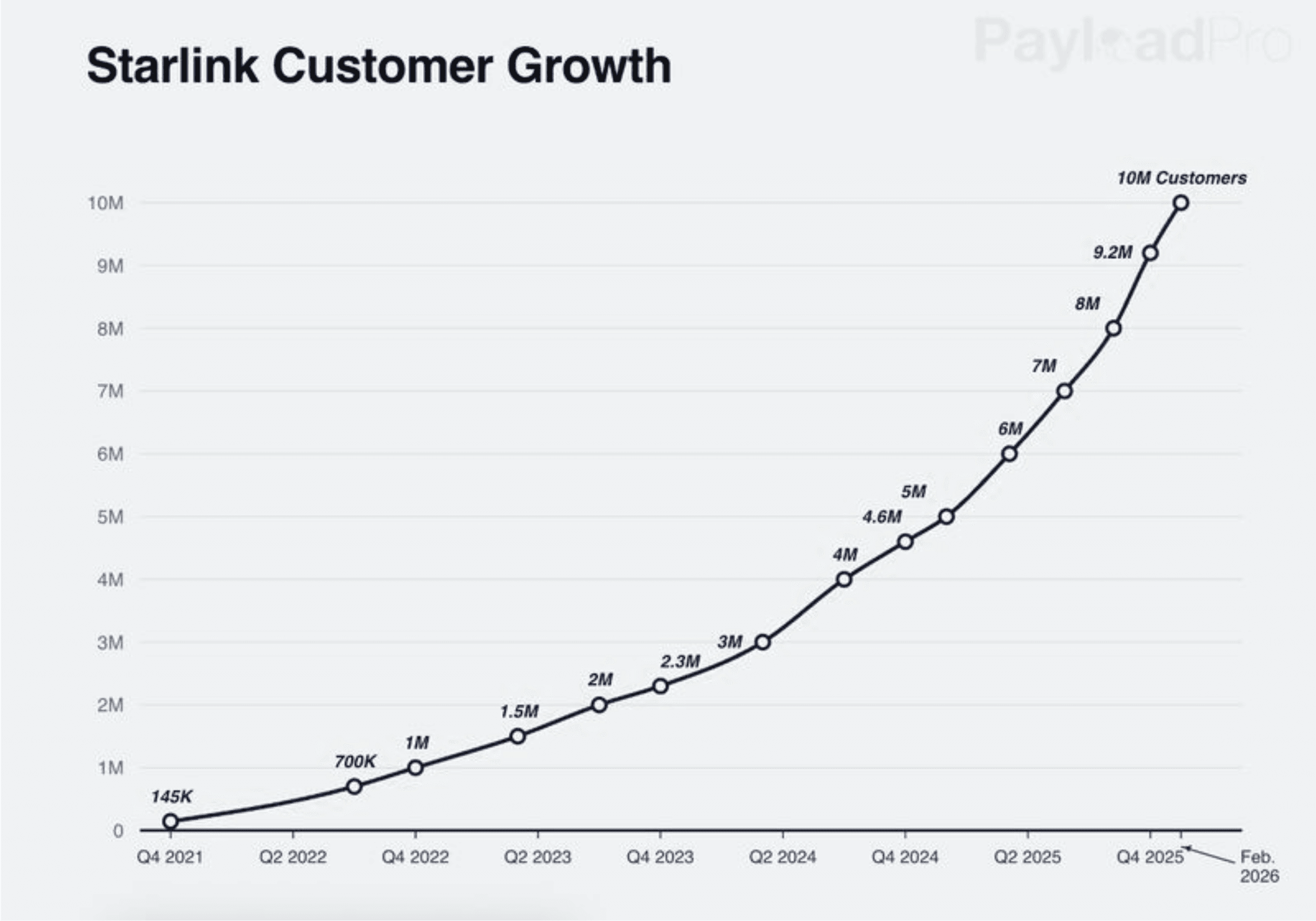
Starlink subscriber growth, 2021–2026. Source: Jack Kuhr, Payload Space
In April, SpaceX filed confidentially for what, at a reported $1.75 to $2 trillion valuation, would be the largest IPO in history. The pace isn't a Starlink story so much as a market story: satellite has crossed into infrastructure, and the old distinction between "the internet you get at home" and "the internet you get at the edge of the map" is quietly disappearing. As humans and AI both consume more of it, the telecom infrastructure is sexy again.
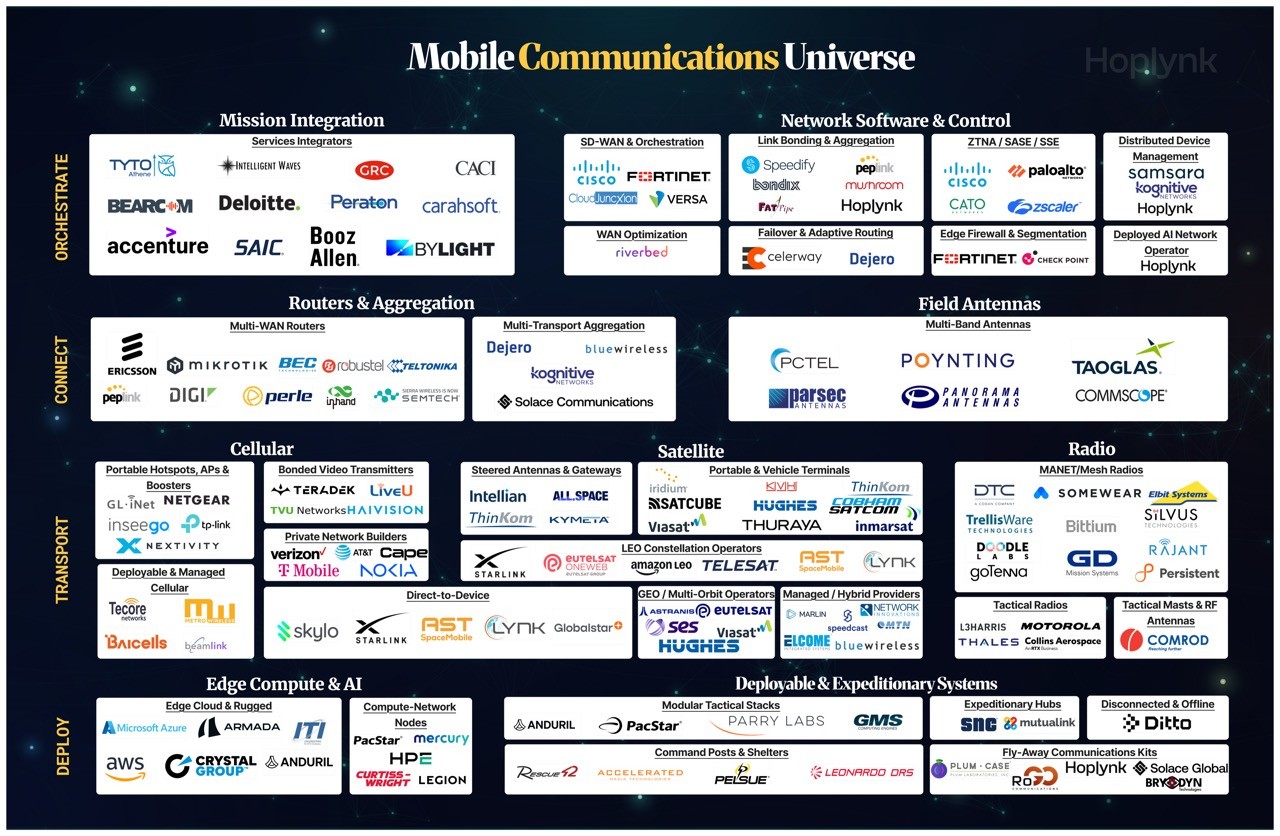
The 2026 Mobile Communications Universe. Download it here:
But the shift goes further than satellite. For most of the past two decades, mobile communications ran on two parallel stacks: a commercial one, built by carriers and enterprise networking vendors for people and businesses, and a defense one, built by primes and specialist contractors for warfighters. The two worlds shared a physics textbook, but not much else. They used different radios, different waveforms, different procurement pathways, different software, and mostly different engineers.
That separation is dissolving. The same SD-WAN logic that routes traffic for a Fortune 500 branch office is now doing PACE-plan failover for a forward operating base. The same mesh radios that let a film crew coordinate on a remote shoot are running drone swarms in contested airspace. The same LEO constellation that streams Netflix to a cabin in Montana is keeping a ship's bridge online through a typhoon. Those building in this market in 2026 are not building a commercial company or a defense company. They are building a company whose stack happens to serve both, because the stack itself has converged.
We built the Mobile Communications Universe to make that convergence legible. The map organizes the entire stack into four functional layers – Orchestrate, Connect, Transport, Deploy. The most interesting companies are not clustered by sector, but clustered by layer.
Before walking the stack, a note on what isn't on it. The platform integrators (Lockheed Martin, Northrop Grumman, Raytheon, General Dynamics, BAE, Boeing, Thales, Saab, Anduril, Shield AI) don't occupy a layer. They consume the stack to build weapons systems, autonomous platforms, and mission software. Their communications business units (GD Mission Systems, Collins Aerospace, Viasat Government Systems, Thales Communications) do appear inside the map, at the layers where they actually compete. A similar pattern exists on the commercial side, where the end buyers (Fortune 500 enterprises, airlines, maritime fleets, emergency services) sit above the stack as consumers. The firms that help them integrate and operate it, like Accenture, Booz Allen, Deloitte, and Microsoft, live inside at the Orchestrate layer because what they deliver is services rather than products.

Orchestrate: the layer that makes networks intelligent
Orchestrate sits at the top of the stack because everything below it is increasingly too complex to operate by hand. A tactical network today can have four or five transports available at once, including LTE, Ku-band, Ka-band, MANET, line-of-sight radio, traditional fiber, etc., each with different costs, latencies, throughput, bandwidth, and survivability profiles. A human operator deciding which path to use, when to fail over, what to prioritize, is fundamentally a bottleneck. Software that makes those decisions is the network.
Network software & control
This is the layer where commercial convergence is most visible.
SD-WAN and SASE
Led by Cisco, Fortinet, Palo Alto, Cato, Versa, and Zscaler, SD-WAN was built for enterprise branch offices, manned by tons of network engineers, and is now being pulled into tactical deployments because the underlying problem is the same: route traffic intelligently across heterogeneous transports with security baked in. Cisco still sets the enterprise standard by virtue of installed base; Cato and Versa are the ones worth watching because they were built cloud-native and don't carry the legacy of appliance-era SD-WAN. It's reasonable to expect one of them to land a serious DoD deal in the next 18 months, as smaller players like CloudJuncxion have successfully piloted in the space. Fortinet and Palo Alto dominate the security conversation, but their tactical stories lag their enterprise stories. The integration work to make SASE genuinely viable in denied environments doesn't appear to have been done yet, by anyone.
Link bonding and aggregation
What's better than 2 individual links? Combining them into one. Companies like Peplink, Bondix, Speedify, Mushroom, FatPipe, and others all came from broadcast and consumer mobility, and are now the default way to squeeze reliability out of multi-WAN at the edge. Peplink is the volume leader by a wide margin and the de facto hardware standard; Bondix and Speedify compete on software-first bonding. The category is crowded at the low end and undifferentiated in the middle. The interesting work is happening at the top, where bonding becomes less about static SpeedFusion tunnels and more about AI-driven path selection that responds to jamming, congestion, and spoofing in real time. Hoplynk and other newcomers are targeting these problems.
ZTNA, SASE, and SSE
The enterprise security story is arriving at the tactical edge. Palo Alto and Zscaler own the Fortune 500 conversation, and Cato is the architectural challenger. For defense, the question isn't who wins enterprise, but who does the work to make zero-trust genuinely operable when your network is intermittent, bandwidth-starved, and degraded. None of the commercial leaders have demonstrated substantive material penetration into the legacy DOD tech stacks. This isn't for a lack of trying, or a lack of government leaders discussing zero-trust architectures in public forums. It seems to be blocked by a mismatch between commercial system design and the physical architecture of defense systems, coupled with some recalcitrant individuals in the "frozen middle" of government IT.
Distributed device management
This was Samsara selling telematics to trucking fleets before it became a model for managing thousands of radios across a joint operation. Samsara is the category-defining commercial player and an increasingly credible dual-use one; Kognitive is gunning for the purpose-built defense play. Armada has also entered the chat. This category gets less attention than SD-WAN but is arguably more strategically important. Whoever owns the device management layer begins to own the customer relationship. Hoplynk has also aimed to bridge the gap between device utilization and management with its Argus platform.
Failover and adaptive routing
This is the bread and butter of Celerway and Dejero. As a category that should probably not exist as a standalone, these capabilities are being absorbed into SD-WAN and link bonding above, and into routers below. The mighty-yet-small Dejero has the most to lose here; their broadcast business is strong but the tactical adjacency is getting eaten from both sides. However, they've done an incredible job of partnering with many companies, and I'd expect to see them acquired in the near future, both for the added value of their capabilities to the acquirer and the defensive denial of those same capabilities to an acquirer's competitors.
Edge firewall, segmentation, and WAN optimization
Largely dominated by Fortinet, Check Point, Riverbed, and a handful of others. These mature commercial categories have been playing defense. Fortinet is the only one with a genuine tactical story. Riverbed is what commoditization looks like at the end state: a once-important category reduced to a single logo on a market map.
Deployed AI network operator
A new category is emerging at this layer that doesn't have a commercial analog yet. The idea is simple. While enterprises have large-headcount IT staffs to monitor disparate SD-WAN, Firewall, and Device Management software suites, these centralized teams do not scale to the deployed edge. Tactical communicators in DOD, the S6s and G6s that contain the network engineers embedded with maneuver units, are overloaded. A battalion S6 is responsible for planning, deploying, securing, and maintaining a multi-transport network for a formation that can span hundreds of kilometers, may displace at a moment's notice, with a team that's typically undermanned and a stack that's hard to properly configure. This is only complicated by adversarial actions and the unlimited permutations of what works at a given moment, local topology, and local staff availability. The existing solution has always been throwing more signal soldiers at the problem, which clearly doesn't scale (especially when signals emissions are so highly targeted by adversaries). The clear solution is a series of AI agents that watch the network in real time, predict congestion and jamming, and reconfigure the stack without a human in the loop. Providing the choice for local or central management, this is the best way to scale network reach and presence without increasing or endangering headcount.
This is the logical endpoint of the automation trend that started in commercial SD-WAN a decade ago, and the AI-for-network-operations trend that Cisco, Arista, and Juniper have been pushing into enterprise for the last five years. The tactical edge has different constraints, like intermittent connectivity, adversarial RF, and hard real-time requirements, but the underlying problem remains the same and the solution is inevitable. Hoplynk is building in this category. So will others. We expect this to attract the most concentrated investment in the Orchestrate layer over the next 24 months, and we expect the first major DoD contract for a deployed AI radio operator to drop inside that window. When it does, it will reset expectations for what "tactical communications" means.
Mission services & integration
Services integrators
The integrators inside the stack, including Peraton, CACI, SAIC, Carahsoft, BEARCOM, GRC, Tyto Athene, By Light, and on the commercial side Accenture Federal, Booz Allen, and Deloitte Federal, are not building pure software. They're assembling stacks from the components below and delivering them as programs. Regardless of their size, they live in Orchestrate because integration is an orchestration problem. Think of them as the general contractors of the network. Peraton, Carahsoft, and CACI are the scale leaders in the defense integration business; their advantage is contract portfolio and cleared workforce, not technology. If and when the deployed AI network operator category matures, the integrators are either its biggest channel or its biggest threat, depending on how the first few major deals get structured.

Connect: where decisions become hardware
If Orchestrate is where the network gets smart, Connect is where it gets real.
Mobile communications live or die at the margins; terrain, interference, congestion, movement, weather. The hardware in this layer is the point where a good routing decision turns into an actual packet reaching an actual user, or not. Routers and antennas get less glory than AI agents and satellite constellations, but they determine whether any of that works.
Routers & aggregation
Multi-WAN routers
These are the substrate of modern mobility. The names are not household, but have quietly powered industry for years, including Ericsson (via Cradlepoint), Peplink, Digi, Semtech, MikroTik, Teltonika, Robustel, BEC, Perle, and InHand. Each device is a small, portable aggregation point that can hold and arbitrate between multiple transports (individual ways to broadcast and receive your communications). This category is almost entirely commercial-origin. The defense market adopted it wholesale because the alternative, purpose-built military routers, were orders of magnitude more expensive, less capable, and updated less frequently. The convergence here is complete. Cradlepoint under Ericsson is the enterprise scale leader with a strong government business; Peplink is the bonded-multi-WAN specialist; MikroTik and Teltonika are the performant-for-the-price plays that keep showing up in unexpected deployments because they just work. The category is healthy, fragmented, and mostly commoditizing. Margin may compress further as volume grows. The winners will be the vendors that integrate cleanly with whatever Orchestrate-layer software ends up dominant, which is why the category is a natural acquisition target for companies higher in the stack.
Multi-transport aggregation
This is really just a narrower category of Multi-WAN routers focused on gateway-level combining of heterogeneous transports (cellular, satellite, fiber, and radio transports) into a unified IP path. Dejero, Blue Wireless, Kognitive, and Solace Global have staked out their claims here. Dejero has the most installed base by virtue of its broadcast origins; Blue Wireless has the cleanest dual-use story. This is a category the link-bonding vendors and the SD-WAN vendors are both trying to claim, and it's not clear if any of the current players will own it when the dust settles. They'll likely either be acquired or driven into smaller niches.
Field antennas
Multi-band antennas
These are the companies most people forget about until the network stops working. If the RF link is bad, everything above it is theoretical. Multi-band capability matters more as spectrum is more contested every year, and the best antennas are the ones that can gracefully shift between frequencies as conditions change. Poynting and Panorama are the go-to specialists for ruggedized multi-band; Taoglas has the broadest portfolio; PCTEL has the strongest U.S. government relationships; Parsec carries the automotive and industrial mobility segments; CommScope brings the scale-telecom pedigree into the category. This is a quietly critical category and one of the few where commercial and defense customers genuinely want the same thing. Expect steered and electronically scanned antennas (which were historically satellite-specific) to keep pushing down into this category over the next few years as the cost curves bend.

Transport: where data actually moves
Transport is the layer most people think of first when they hear "mobile communications," and it's also the layer where the commercial-defense collapse is most obvious. There are three major transport media we focus on for mobility: cellular, satellite, and radio. Traditional ISPs are excluded given their fixed infrastructure. Each of the three is undergoing its own convergence story, and between cellular and satellite, a fourth story is emerging at their seam.
Cellular
Cellular is the mature backbone.
Public networks and private 5G
Verizon, T-Mobile, AT&T, and Nokia run public networks at continental scale, and private 5G from the same players plus Cape and Ericsson is pushing cellular into places it never used to reach, like warehouses, ports, forward operating bases, and oil platforms. The one real wildcard is private 5G: Cape is the most interesting newer entrant, and if a defense-focused private 5G company emerges that can actually ship hardware at scale, it changes the deployable cellular category materially.
Deployable and managed cellular
Tecore, MetroWireless, Baicells, and Beamlink extend the category further, making a private LTE or 5G bubble something you can set up in a parking lot.
Bonded video transmitters
Teradek, LiveU, TVU, and Haivision sit in a strange adjacent category; they came from live broadcast and are increasingly being deployed in DOD's ISR workflows, where the "get the video off the camera and back to the operations center over any available cellular" problem is identical.
Portable hotspots and signal boosters
Netgear, GL.iNet, Inseego, TP-Link, and Nextivity round out the category with low-cost devices converting cellular to local WiFi. Cellular is boring in the sense that the physics and the economics are well understood. It is not boring in the sense that it's losing relevance. It's gaining it.
Direct-to-device
Direct-to-device is the story that sits at the seam between cellular and satellite, and it's the category that most obviously proves the convergence thesis. The premise: your regular cellular phone, wearable, or IoT device, unmodified, connects to a satellite when it can't reach a tower. You don't know it happened. The user experience is cellular; the physics is satellite. It's not really one or the other, so on the map it straddles both.
Vertically-integrated operators
Starlink Mobile (rebranded from Direct-to-Cell at MWC 2026), AST SpaceMobile, Lynk, and Amazon Leo via the Globalstar acquisition are all building the D2D service end-to-end on their own spectrum. The constellation operator owns the customer relationship, the network, and the spectrum it runs on.
Standards-based NTN
Our friends at Skylo anchor the horizontal, standards-based approach. Rather than build satellites or terminals, Skylo operates a 3GPP-compliant virtualized RAN that sits between constellation operators (Viasat, Inmarsat) and device makers (Samsung, Qualcomm, Google, Garmin), enabling any certified cellular device to seamlessly roam onto satellite. Apple's D2D feature historically ran on Globalstar and now finds itself inside Amazon Leo; that's a relationship to watch carefully over the next 18 months.
My bet is that both models coexist. The vertically-integrated D2D operators will own the premium consumer and enterprise relationships, while the standards-based NTN layer will become the plumbing for the long tail of IoT, wearables, and lower-ARPU consumer devices. Either way, D2D becomes a default feature rather than a premium one within 24 months, which fundamentally changes what "cellular coverage" and "satellite coverage" mean.
Satellite
Satellite is where the market is being rewritten in real time. A decade ago, satellite was a backup: expensive, high-latency, used when nothing else worked. LEO constellations have rewritten that. Starlink has helped change the service narrative from "the thing you use when fiber isn't available" to a genuine continental-scale broadband layer. But Starlink is no longer the only story.
LEO constellation operators
Amazon Leo (formerly Project Kuiper) entered enterprise beta in April 2026 with terminals that claim up to 1 Gbps and specific positioning against Starlink on enterprise. Amazon has between 210 and 241 production satellites in orbit against an FCC requirement of 1,618 by July 2026, is asking for a two-year extension, and just announced an $11.6 billion acquisition of Globalstar in mid-April to pick up spectrum and a regulatory fast-pass for mobile services. That deal also solidifies a tripartite arrangement with Apple, who had previously relied on Globalstar for Emergency SOS. Read that carefully: the second-largest LEO broadband player just bought the spectrum and relationships it needed to compete with Starlink Mobile on direct-to-device. This is now a two-player race at the top of the category, with AST SpaceMobile, Lynk, Eutelsat OneWeb, and Telesat (via its Lightspeed constellation) fighting for position underneath.
GEO / multi-orbit operators
Viasat, SES, Hughes, and Eutelsat aren't going away. They provide the persistent throughput that LEO swarms still struggle to guarantee in dense or high-demand conditions, and they own most of the existing government SATCOM contracts. But their growth story is defense-specific now; the commercial GEO broadband narrative is effectively over. Viasat has partnered with Telesat to become multi-orbit, and the SES-Intelsat combination are the late-consolidation moves of a maturing category. Astranis is a peculiar addition to a category that has seen tremendous contraction.
Terminals and steered antennas
Intellian, Kymeta, ThinKom, ALL.SPACE, Cobham SATCOM, KVH, and Iridium are a quietly enormous market of their own and one of the most genuinely dual-use sub-categories on the entire map. Kymeta is the household name in steered flat-panel; ALL.SPACE is the one to watch if multi-beam becomes the default, if only for enterprise customers. Alongside them, Inmarsat, Thuraya, Satcube, Viasat Government Systems, and Hughes round out the portable and vehicle terminal ecosystem, with heavy installed bases across maritime, aviation, and tactical. As costs drop, consumers may have more choice than traditional vendor-provided hardware.
Managed and hybrid providers
Speedcast, Marlink, Blue Wireless, Network Innovations, Elcome, and MTN are the layer above that packages all of this into a service for maritime, aviation, and remote enterprise customers. Speedcast is the scale leader; Blue Wireless is the most agile. SATCOM has always served both sides. The difference now is that both sides are buying from the same vendors, often on the same contracts, and the vendors increasingly don't distinguish.
Radio
Radio is the category that still belongs mostly to defense, and the one with the sharpest ongoing action. This is also the sub-layer where the most money has moved recently, so it deserves unpacking.
MANET and mesh radios
Silvus, TrellisWare, Persistent Systems, Rajant, goTenna (acquired by Forterra), Doodle Labs, DTC, Somewear, Bittium, GD Mission Systems, and Elbit solve a problem the other two transports can't: self-forming networks that survive when cellular towers are gone, when satellite is jammed, when there is no fixed infrastructure and won't be any. Silvus is the scale leader and was just acquired by Motorola for $4.4 billion. TrellisWare is the waveform-first competitor with deep SOF relationships and the TSM ecosystem around it. Persistent Systems (the Wave Relay people) has the entrenched Army and law enforcement installed base. Rajant is the industrial-commercial dual-use play. goTenna has the asymmetric advantage: low-cost, low-bandwidth, hard-to-detect, with a natural bolt-on role for autonomous ground vehicles. GD Mission Systems and Elbit bring prime-scale integration and international reach. It's the most competitive category on the map and the one most actively being rearranged by M&A.
The strategic read: Silvus going to Motorola and goTenna going to Forterra are not coincidental. They're two different theories of what MANET converges toward. Motorola's bet is that MANET becomes part of a public-safety-and-commercial-security portfolio, that the same mesh network that runs a counter-UAS operation also runs a festival security deployment or a border patrol grid. Having lost a number of state contracts to Harris in the first half of this decade, this is a brilliant bet to regain ground. Forterra's bet is that MANET becomes inseparable from autonomous systems, that every robot is a radio and every radio is part of the C2 for a swarm of robots. Both are defensible theses and both are probably partially right. The companies in this category still independent (TrellisWare, Persistent, Rajant, Doodle Labs) are now sitting in the middle of two distinct acquirer pools (security primes and autonomy primes), which is a good problem to have.
Tactical radios
L3Harris, Collins Aerospace (RTX), Thales Communications, and Motorola are the legacy handheld-voice category, still dominant in fielded inventories but losing ground to the mesh players on anything data-heavy. L3Harris is the unambiguous market leader and has billions in Falcon-series handheld inventory fielded globally. The bigger question is whether L3Harris, or any of the legacy radio primes, will meaningfully compete in the mesh era, or whether that future belongs to the specialists they didn't acquire in time. If you want to know which category is about to get interesting, watch how the next wave of M&A reshapes the border between legacy tactical radio and MANET.
Tactical masts and RF antennas
Comrod is the specialist worth knowing here. Masts are the physical scaffolding that lets everything above work in the field, and the category is small, quiet, and durable. Not a place to expect disruption, but a place where getting it wrong means nothing else works.

Deploy: bringing the network to the edge
The Deploy layer is the one that has changed the most in the last three years, because this is where the shift from "connectivity at the edge" to "operations at the edge" is playing out.
Edge compute & AI
Edge cloud and rugged
This is the story of hyperscalers and rugged specialists meeting in the middle. Microsoft Azure and AWS extended their cloud offerings outward, ruggedized their containers, and started shipping appliances that run real workloads in the field. Armada is the most interesting commercial-side player; their Galleon shipping-container data center and rugged edge boxes are being pulled into defense programs quickly. On the defense side, Crystal Group, ITI, and Anduril (via the former Klas team’s integration into the Menace product line) are competing for the ruggedized-edge-compute slot.
Compute-network nodes
HPE, PacStar, Mercury Systems, Curtiss-Wright (the PacStar parent), and Legion are the category where compute and networking explicitly fuse into a single deployable module. PacStar is the entrenched incumbent with deep Army and Marine Corps program positions (WIN-T/PM-TN, Marine Corps Combat Data Network), and Curtiss-Wright has been aggressively modernizing the portfolio. The PacStar 465 launched in January 2025 for transport diversity, the 466/467 radio gateways in October, a new Universal Smart Chassis in November, and the 424 Tactical 5G Gateway to integrate 5G, Wi-Fi 6 and SATCOM routing just last week. They're defending their position seriously, which matters because the challenger set is now unusually strong. What you end up with is a fabric where the compute and the network are no longer separable. Inference happens at the same node that does the routing, and the old distinction between "the cloud" and "the edge" is gone.
Deployable & expeditionary systems
Modular tactical stacks
This is the category where the whole stack gets packaged into something a team can carry, and the most important category-level development in this layer is the Army's $20 billion enterprise contract with Anduril, announced in March 2026. That contract consolidates more than 120 previous Anduril procurement actions into a single vehicle and explicitly covers not just the Lattice software but the hardware, compute infrastructure, and communications that make up the Menace family of expeditionary C2 systems. Menace-T and Menace-X are now the named competitors for the modular tactical stack category, and the Anduril/Klas integration is specifically what enables them. Anduril effectively just became a prime-scale player in a category that used to be defined by PacStar's and others’ dominance of the Army's tactical network programs.
That doesn't mean PacStar is displaced. The Army doesn't replace an entire fielded program overnight, and the Curtiss-Wright/PacStar portfolio is deeply embedded in sustainment, spares, and the specific form factors existing units already train on. But it does mean that the "buy the modular tactical stack" purchasing motion is no longer a PacStar or Viasat conversation by default. It's a PacStar-or-Anduril conversation, with Parry Labs, GMS, and smaller specialist builders competing for specific sub-slots that neither giant wants. The second-order effect to watch is which modular tactical stack the various MANET and SATCOM vendors choose to natively integrate with. That's where the partner ecosystems are getting redrawn right now.
Command posts and shelters
Rescue 42, Accelerated Media Technologies, Pelsue, and Leonardo DRS are the tent-plus-power layer (or systems designed to fit in a tent/trailer) that everything else plugs into or deliver comms for a mobile site; Leonardo DRS is the prime-scale player, the rest are specialists competing on form factor. There are dozens of companies that specialize in designing trailers and vehicles with integrated communications suites that we have excluded from this market map.
Fly-away communications kits
Plum Case, Ro2 Comms, and Hoplynk package the full stack into a smaller transit-case footprint for teams that need to deploy in minutes, not days. These modular kits provide multi-path comms so connectivity is assured regardless of the condition of local infrastructure.
Expeditionary hubs
SNC and Mutualink are the emergency-management-adjacent category, genuinely dual-use (the same kit that responds to a wildfire is useful for a battalion forward node).
Disconnected and offline
Ditto is driving a new category with effectively one serious player; expect more entrants as data-synchronization-in-denied-environments becomes a first-class requirement rather than an afterthought. What works for Chick-fil-A also works great for Customs and Border Patrol.
This is where dual-use is most contested, because "deploy to an austere environment" describes both a special operations raid and a hurricane response. The companies here have to build for both, and the ones that do it well are the ones that will own this layer.
Where the money is moving
If you don't believe any of this, look at the M&A.
Motorola acquired Silvus in August 2025 for $4.4 billion. Silvus is a MANET radio company; Motorola is a public safety and commercial communications company. The transaction is what convergence looks like: a commercial-origin communications vendor paying premium multiples for a defense-origin mesh networking company, because the category is what matters.
Anduril acquired Klas in July 2025. Klas makes the Voyager family of ruggedized edge compute and networking hardware; Anduril is the platform and software company that consumes exactly that kind of hardware. Vertical integration from software through compute into network. Seven months later, the Army awarded Anduril a 10-year enterprise contract worth up to $20 billion that explicitly covers the Menace family of expeditionary systems, the systems the Klas hardware now underpins. The acquisition was a critical enabling factor for the enterprise contract payoff.
Forterra acquired goTenna in October 2025. Forterra builds autonomous ground vehicles; goTenna builds low-cost, hard-to-detect mesh radios. Two companies that previously would have been seen as occupying different markets working together as partners, a robot company and a comms company, are now vertically integrated.
Amazon acquired Globalstar in April 2026 for $11.6 billion, and rebranded Project Kuiper as Amazon Leo. The deal gives Amazon Globalstar's spectrum, a regulatory fast-pass for mobile services, and the Apple relationship that powers iPhone Emergency SOS. It is the clearest signal yet that the LEO satellite market is a two-player race, and that both of those players are building direct-to-device, not just broadband-to-terminal.
Four transactions in nine months, each of them stitching together layers of the map that used to be separate businesses. None of them is a commercial company buying a commercial company or a defense company buying a defense company. Every one is a cross-layer, cross-origin transaction as companies move towards vertical integration. That's the pattern, and when the pattern holds across radio companies, edge compute companies, autonomous systems companies, and a spectrum-plus-mobile transaction within twelve months, it's not a pattern anymore. It's the structure of the market.
What comes next
The obvious prediction is more of the same: more M&A across the seam, more convergence in the stack, more commercial vendors showing up in defense programs and vice versa. That's true but uninteresting.
The harder prediction is about where the value accrues. Our view is that the Orchestrate and Deploy layers, the software and AI agents at the top and the integrated fieldable systems at the bottom, are where the next decade of margin lives. The Transport and Connect layers in the middle are where the next decade of commoditization happens. Radios will get better and cheaper. Satellites will get denser and faster. Antennas will keep refining. None of that will be where the interesting equity stories are. The interesting stories will be at the two ends of the stack: the layer that decides how to use all of it, and the layer that gets it into the hands of the people who need it.
That's the thesis, and this map is our attempt to make it visible. This thesis is what drives Hoplynk’s mission. If you see the stack differently, we'd like to hear it.
About the author
Andrew Paulmeno is the CEO and Founder of Hoplynk, a technology company building autonomous networking for the edge. Before Hoplynk, he served in the Marine Corps for 10 years, with his last assignment as Head of Product for Project Maven, working with multiple Combatant Commands, NGA, NRO, CDAO, and commercial vendors to deliver AI effects to warfighters. He has also worked at Trunk Tools, Voyager Space, Muon Space, Space Capital, and as an independent consultant on communications.
The opinions in this piece are his own. The market map reflects Hoplynk's view of the landscape as of April 2026, informed by direct customer engagements across DoD, the commercial sector, integration partnerships, and ongoing technical work at the tactical edge.
Hoplynk builds at the Orchestrate and Deploy layers of the stack described above.
For feedback, corrections, or to suggest a company we missed, email us at info@hoplynk.com or connect with us on LinkedIn.
Download the Mobile Communications Universe
Hoplynk makes connectivity effortless.
Join the movement toward autonomous networking.

Technology
Apr 20, 2026
The Mobile Communications Stack
Commercial and Defense are converging
Communications and the internet drove extraordinary economic growth in the late 1990s, and the architecture that made it possible drew the hottest money in Silicon Valley and on Wall Street. After the dotcom bubble burst, the pendulum swung: investors, founders, and the press agreed that the infrastructure was boring and the applications were where the real work lived. That consensus would hold for two decades. Until Starlink came along.
Starlink's growth has been a compounding event in real time. The service took two years to sign its first million customers. Three years after that, in February, it went from nine million to ten million in 53 days, and recent reports show it adding more than 20,000 new customers every day. With four straight quarters of >100% growth, some forecast Starlink at 20M subscribers by year end. Simply put – internet demand and traffic is exploding.
Starlink subscriber growth, 2021–2026. Source: Jack Kuhr, Payload Space
In April, SpaceX filed confidentially for what, at a reported $1.75 to $2 trillion valuation, would be the largest IPO in history. The pace isn't a Starlink story so much as a market story: satellite has crossed into infrastructure, and the old distinction between "the internet you get at home" and "the internet you get at the edge of the map" is quietly disappearing. As humans and AI both consume more of it, the telecom infrastructure is sexy again.
The 2026 Mobile Communications Universe. Download it here:
But the shift goes further than satellite. For most of the past two decades, mobile communications ran on two parallel stacks: a commercial one, built by carriers and enterprise networking vendors for people and businesses, and a defense one, built by primes and specialist contractors for warfighters. The two worlds shared a physics textbook, but not much else. They used different radios, different waveforms, different procurement pathways, different software, and mostly different engineers.
That separation is dissolving. The same SD-WAN logic that routes traffic for a Fortune 500 branch office is now doing PACE-plan failover for a forward operating base. The same mesh radios that let a film crew coordinate on a remote shoot are running drone swarms in contested airspace. The same LEO constellation that streams Netflix to a cabin in Montana is keeping a ship's bridge online through a typhoon. Those building in this market in 2026 are not building a commercial company or a defense company. They are building a company whose stack happens to serve both, because the stack itself has converged.
We built the Mobile Communications Universe to make that convergence legible. The map organizes the entire stack into four functional layers – Orchestrate, Connect, Transport, Deploy. The most interesting companies are not clustered by sector, but clustered by layer.
Before walking the stack, a note on what isn't on it. The platform integrators (Lockheed Martin, Northrop Grumman, Raytheon, General Dynamics, BAE, Boeing, Thales, Saab, Anduril, Shield AI) don't occupy a layer. They consume the stack to build weapons systems, autonomous platforms, and mission software. Their communications business units (GD Mission Systems, Collins Aerospace, Viasat Government Systems, Thales Communications) do appear inside the map, at the layers where they actually compete. A similar pattern exists on the commercial side, where the end buyers (Fortune 500 enterprises, airlines, maritime fleets, emergency services) sit above the stack as consumers. The firms that help them integrate and operate it, like Accenture, Booz Allen, Deloitte, and Microsoft, live inside at the Orchestrate layer because what they deliver is services rather than products.
Orchestrate: the layer that makes networks intelligent
Orchestrate sits at the top of the stack because everything below it is increasingly too complex to operate by hand. A tactical network today can have four or five transports available at once, including LTE, Ku-band, Ka-band, MANET, line-of-sight radio, traditional fiber, etc., each with different costs, latencies, throughput, bandwidth, and survivability profiles. A human operator deciding which path to use, when to fail over, what to prioritize, is fundamentally a bottleneck. Software that makes those decisions is the network.
Network software & control
This is the layer where commercial convergence is most visible.
SD-WAN and SASE
Led by Cisco, Fortinet, Palo Alto, Cato, Versa, and Zscaler, SD-WAN was built for enterprise branch offices, manned by tons of network engineers, and is now being pulled into tactical deployments because the underlying problem is the same: route traffic intelligently across heterogeneous transports with security baked in. Cisco still sets the enterprise standard by virtue of installed base; Cato and Versa are the ones worth watching because they were built cloud-native and don't carry the legacy of appliance-era SD-WAN. It's reasonable to expect one of them to land a serious DoD deal in the next 18 months, as smaller players like CloudJuncxion have successfully piloted in the space. Fortinet and Palo Alto dominate the security conversation, but their tactical stories lag their enterprise stories. The integration work to make SASE genuinely viable in denied environments doesn't appear to have been done yet, by anyone.
Link bonding and aggregation
What's better than 2 individual links? Combining them into one. Companies like Peplink, Bondix, Speedify, Mushroom, FatPipe, and others all came from broadcast and consumer mobility, and are now the default way to squeeze reliability out of multi-WAN at the edge. Peplink is the volume leader by a wide margin and the de facto hardware standard; Bondix and Speedify compete on software-first bonding. The category is crowded at the low end and undifferentiated in the middle. The interesting work is happening at the top, where bonding becomes less about static SpeedFusion tunnels and more about AI-driven path selection that responds to jamming, congestion, and spoofing in real time. Hoplynk and other newcomers are targeting these problems.
ZTNA, SASE, and SSE
The enterprise security story is arriving at the tactical edge. Palo Alto and Zscaler own the Fortune 500 conversation, and Cato is the architectural challenger. For defense, the question isn't who wins enterprise, but who does the work to make zero-trust genuinely operable when your network is intermittent, bandwidth-starved, and degraded. None of the commercial leaders have demonstrated substantive material penetration into the legacy DOD tech stacks. This isn't for a lack of trying, or a lack of government leaders discussing zero-trust architectures in public forums. It seems to be blocked by a mismatch between commercial system design and the physical architecture of defense systems, coupled with some recalcitrant individuals in the "frozen middle" of government IT.
Distributed device management
This was Samsara selling telematics to trucking fleets before it became a model for managing thousands of radios across a joint operation. Samsara is the category-defining commercial player and an increasingly credible dual-use one; Kognitive is gunning for the purpose-built defense play. Armada has also entered the chat. This category gets less attention than SD-WAN but is arguably more strategically important. Whoever owns the device management layer begins to own the customer relationship. Hoplynk has also aimed to bridge the gap between device utilization and management with its Argus platform.
Failover and adaptive routing
This is the bread and butter of Celerway and Dejero. As a category that should probably not exist as a standalone, these capabilities are being absorbed into SD-WAN and link bonding above, and into routers below. The mighty-yet-small Dejero has the most to lose here; their broadcast business is strong but the tactical adjacency is getting eaten from both sides. However, they've done an incredible job of partnering with many companies, and I'd expect to see them acquired in the near future, both for the added value of their capabilities to the acquirer and the defensive denial of those same capabilities to an acquirer's competitors.
Edge firewall, segmentation, and WAN optimization
Largely dominated by Fortinet, Check Point, Riverbed, and a handful of others. These mature commercial categories have been playing defense. Fortinet is the only one with a genuine tactical story. Riverbed is what commoditization looks like at the end state: a once-important category reduced to a single logo on a market map.
Deployed AI network operator
A new category is emerging at this layer that doesn't have a commercial analog yet. The idea is simple. While enterprises have large-headcount IT staffs to monitor disparate SD-WAN, Firewall, and Device Management software suites, these centralized teams do not scale to the deployed edge. Tactical communicators in DOD, the S6s and G6s that contain the network engineers embedded with maneuver units, are overloaded. A battalion S6 is responsible for planning, deploying, securing, and maintaining a multi-transport network for a formation that can span hundreds of kilometers, may displace at a moment's notice, with a team that's typically undermanned and a stack that's hard to properly configure. This is only complicated by adversarial actions and the unlimited permutations of what works at a given moment, local topology, and local staff availability. The existing solution has always been throwing more signal soldiers at the problem, which clearly doesn't scale (especially when signals emissions are so highly targeted by adversaries). The clear solution is a series of AI agents that watch the network in real time, predict congestion and jamming, and reconfigure the stack without a human in the loop. Providing the choice for local or central management, this is the best way to scale network reach and presence without increasing or endangering headcount.
This is the logical endpoint of the automation trend that started in commercial SD-WAN a decade ago, and the AI-for-network-operations trend that Cisco, Arista, and Juniper have been pushing into enterprise for the last five years. The tactical edge has different constraints, like intermittent connectivity, adversarial RF, and hard real-time requirements, but the underlying problem remains the same and the solution is inevitable. Hoplynk is building in this category. So will others. We expect this to attract the most concentrated investment in the Orchestrate layer over the next 24 months, and we expect the first major DoD contract for a deployed AI radio operator to drop inside that window. When it does, it will reset expectations for what "tactical communications" means.
Mission services & integration
Services integrators
The integrators inside the stack, including Peraton, CACI, SAIC, Carahsoft, BEARCOM, GRC, Tyto Athene, By Light, and on the commercial side Accenture Federal, Booz Allen, and Deloitte Federal, are not building pure software. They're assembling stacks from the components below and delivering them as programs. Regardless of their size, they live in Orchestrate because integration is an orchestration problem. Think of them as the general contractors of the network. Peraton, Carahsoft, and CACI are the scale leaders in the defense integration business; their advantage is contract portfolio and cleared workforce, not technology. If and when the deployed AI network operator category matures, the integrators are either its biggest channel or its biggest threat, depending on how the first few major deals get structured.
Connect: where decisions become hardware
If Orchestrate is where the network gets smart, Connect is where it gets real.
Mobile communications live or die at the margins; terrain, interference, congestion, movement, weather. The hardware in this layer is the point where a good routing decision turns into an actual packet reaching an actual user, or not. Routers and antennas get less glory than AI agents and satellite constellations, but they determine whether any of that works.
Routers & aggregation
Multi-WAN routers
These are the substrate of modern mobility. The names are not household, but have quietly powered industry for years, including Ericsson (via Cradlepoint), Peplink, Digi, Semtech, MikroTik, Teltonika, Robustel, BEC, Perle, and InHand. Each device is a small, portable aggregation point that can hold and arbitrate between multiple transports (individual ways to broadcast and receive your communications). This category is almost entirely commercial-origin. The defense market adopted it wholesale because the alternative, purpose-built military routers, were orders of magnitude more expensive, less capable, and updated less frequently. The convergence here is complete. Cradlepoint under Ericsson is the enterprise scale leader with a strong government business; Peplink is the bonded-multi-WAN specialist; MikroTik and Teltonika are the performant-for-the-price plays that keep showing up in unexpected deployments because they just work. The category is healthy, fragmented, and mostly commoditizing. Margin may compress further as volume grows. The winners will be the vendors that integrate cleanly with whatever Orchestrate-layer software ends up dominant, which is why the category is a natural acquisition target for companies higher in the stack.
Multi-transport aggregation
This is really just a narrower category of Multi-WAN routers focused on gateway-level combining of heterogeneous transports (cellular, satellite, fiber, and radio transports) into a unified IP path. Dejero, Blue Wireless, Kognitive, and Solace Global have staked out their claims here. Dejero has the most installed base by virtue of its broadcast origins; Blue Wireless has the cleanest dual-use story. This is a category the link-bonding vendors and the SD-WAN vendors are both trying to claim, and it's not clear if any of the current players will own it when the dust settles. They'll likely either be acquired or driven into smaller niches.
Field antennas
Multi-band antennas
These are the companies most people forget about until the network stops working. If the RF link is bad, everything above it is theoretical. Multi-band capability matters more as spectrum is more contested every year, and the best antennas are the ones that can gracefully shift between frequencies as conditions change. Poynting and Panorama are the go-to specialists for ruggedized multi-band; Taoglas has the broadest portfolio; PCTEL has the strongest U.S. government relationships; Parsec carries the automotive and industrial mobility segments; CommScope brings the scale-telecom pedigree into the category. This is a quietly critical category and one of the few where commercial and defense customers genuinely want the same thing. Expect steered and electronically scanned antennas (which were historically satellite-specific) to keep pushing down into this category over the next few years as the cost curves bend.
Transport: where data actually moves
Transport is the layer most people think of first when they hear "mobile communications," and it's also the layer where the commercial-defense collapse is most obvious. There are three major transport media we focus on for mobility: cellular, satellite, and radio. Traditional ISPs are excluded given their fixed infrastructure. Each of the three is undergoing its own convergence story, and between cellular and satellite, a fourth story is emerging at their seam.
Cellular
Cellular is the mature backbone.
Public networks and private 5G
Verizon, T-Mobile, AT&T, and Nokia run public networks at continental scale, and private 5G from the same players plus Cape and Ericsson is pushing cellular into places it never used to reach, like warehouses, ports, forward operating bases, and oil platforms. The one real wildcard is private 5G: Cape is the most interesting newer entrant, and if a defense-focused private 5G company emerges that can actually ship hardware at scale, it changes the deployable cellular category materially.
Deployable and managed cellular
Tecore, MetroWireless, Baicells, and Beamlink extend the category further, making a private LTE or 5G bubble something you can set up in a parking lot.
Bonded video transmitters
Teradek, LiveU, TVU, and Haivision sit in a strange adjacent category; they came from live broadcast and are increasingly being deployed in DOD's ISR workflows, where the "get the video off the camera and back to the operations center over any available cellular" problem is identical.
Portable hotspots and signal boosters
Netgear, GL.iNet, Inseego, TP-Link, and Nextivity round out the category with low-cost devices converting cellular to local WiFi. Cellular is boring in the sense that the physics and the economics are well understood. It is not boring in the sense that it's losing relevance. It's gaining it.
Direct-to-device
Direct-to-device is the story that sits at the seam between cellular and satellite, and it's the category that most obviously proves the convergence thesis. The premise: your regular cellular phone, wearable, or IoT device, unmodified, connects to a satellite when it can't reach a tower. You don't know it happened. The user experience is cellular; the physics is satellite. It's not really one or the other, so on the map it straddles both.
Vertically-integrated operators
Starlink Mobile (rebranded from Direct-to-Cell at MWC 2026), AST SpaceMobile, Lynk, and Amazon Leo via the Globalstar acquisition are all building the D2D service end-to-end on their own spectrum. The constellation operator owns the customer relationship, the network, and the spectrum it runs on.
Standards-based NTN
Our friends at Skylo anchor the horizontal, standards-based approach. Rather than build satellites or terminals, Skylo operates a 3GPP-compliant virtualized RAN that sits between constellation operators (Viasat, Inmarsat) and device makers (Samsung, Qualcomm, Google, Garmin), enabling any certified cellular device to seamlessly roam onto satellite. Apple's D2D feature historically ran on Globalstar and now finds itself inside Amazon Leo; that's a relationship to watch carefully over the next 18 months.
My bet is that both models coexist. The vertically-integrated D2D operators will own the premium consumer and enterprise relationships, while the standards-based NTN layer will become the plumbing for the long tail of IoT, wearables, and lower-ARPU consumer devices. Either way, D2D becomes a default feature rather than a premium one within 24 months, which fundamentally changes what "cellular coverage" and "satellite coverage" mean.
Satellite
Satellite is where the market is being rewritten in real time. A decade ago, satellite was a backup: expensive, high-latency, used when nothing else worked. LEO constellations have rewritten that. Starlink has helped change the service narrative from "the thing you use when fiber isn't available" to a genuine continental-scale broadband layer. But Starlink is no longer the only story.
LEO constellation operators
Amazon Leo (formerly Project Kuiper) entered enterprise beta in April 2026 with terminals that claim up to 1 Gbps and specific positioning against Starlink on enterprise. Amazon has between 210 and 241 production satellites in orbit against an FCC requirement of 1,618 by July 2026, is asking for a two-year extension, and just announced an $11.6 billion acquisition of Globalstar in mid-April to pick up spectrum and a regulatory fast-pass for mobile services. That deal also solidifies a tripartite arrangement with Apple, who had previously relied on Globalstar for Emergency SOS. Read that carefully: the second-largest LEO broadband player just bought the spectrum and relationships it needed to compete with Starlink Mobile on direct-to-device. This is now a two-player race at the top of the category, with AST SpaceMobile, Lynk, Eutelsat OneWeb, and Telesat (via its Lightspeed constellation) fighting for position underneath.
GEO / multi-orbit operators
Viasat, SES, Hughes, and Eutelsat aren't going away. They provide the persistent throughput that LEO swarms still struggle to guarantee in dense or high-demand conditions, and they own most of the existing government SATCOM contracts. But their growth story is defense-specific now; the commercial GEO broadband narrative is effectively over. Viasat has partnered with Telesat to become multi-orbit, and the SES-Intelsat combination are the late-consolidation moves of a maturing category. Astranis is a peculiar addition to a category that has seen tremendous contraction.
Terminals and steered antennas
Intellian, Kymeta, ThinKom, ALL.SPACE, Cobham SATCOM, KVH, and Iridium are a quietly enormous market of their own and one of the most genuinely dual-use sub-categories on the entire map. Kymeta is the household name in steered flat-panel; ALL.SPACE is the one to watch if multi-beam becomes the default, if only for enterprise customers. Alongside them, Inmarsat, Thuraya, Satcube, Viasat Government Systems, and Hughes round out the portable and vehicle terminal ecosystem, with heavy installed bases across maritime, aviation, and tactical. As costs drop, consumers may have more choice than traditional vendor-provided hardware.
Managed and hybrid providers
Speedcast, Marlink, Blue Wireless, Network Innovations, Elcome, and MTN are the layer above that packages all of this into a service for maritime, aviation, and remote enterprise customers. Speedcast is the scale leader; Blue Wireless is the most agile. SATCOM has always served both sides. The difference now is that both sides are buying from the same vendors, often on the same contracts, and the vendors increasingly don't distinguish.
Radio
Radio is the category that still belongs mostly to defense, and the one with the sharpest ongoing action. This is also the sub-layer where the most money has moved recently, so it deserves unpacking.
MANET and mesh radios
Silvus, TrellisWare, Persistent Systems, Rajant, goTenna (acquired by Forterra), Doodle Labs, DTC, Somewear, Bittium, GD Mission Systems, and Elbit solve a problem the other two transports can't: self-forming networks that survive when cellular towers are gone, when satellite is jammed, when there is no fixed infrastructure and won't be any. Silvus is the scale leader and was just acquired by Motorola for $4.4 billion. TrellisWare is the waveform-first competitor with deep SOF relationships and the TSM ecosystem around it. Persistent Systems (the Wave Relay people) has the entrenched Army and law enforcement installed base. Rajant is the industrial-commercial dual-use play. goTenna has the asymmetric advantage: low-cost, low-bandwidth, hard-to-detect, with a natural bolt-on role for autonomous ground vehicles. GD Mission Systems and Elbit bring prime-scale integration and international reach. It's the most competitive category on the map and the one most actively being rearranged by M&A.
The strategic read: Silvus going to Motorola and goTenna going to Forterra are not coincidental. They're two different theories of what MANET converges toward. Motorola's bet is that MANET becomes part of a public-safety-and-commercial-security portfolio, that the same mesh network that runs a counter-UAS operation also runs a festival security deployment or a border patrol grid. Having lost a number of state contracts to Harris in the first half of this decade, this is a brilliant bet to regain ground. Forterra's bet is that MANET becomes inseparable from autonomous systems, that every robot is a radio and every radio is part of the C2 for a swarm of robots. Both are defensible theses and both are probably partially right. The companies in this category still independent (TrellisWare, Persistent, Rajant, Doodle Labs) are now sitting in the middle of two distinct acquirer pools (security primes and autonomy primes), which is a good problem to have.
Tactical radios
L3Harris, Collins Aerospace (RTX), Thales Communications, and Motorola are the legacy handheld-voice category, still dominant in fielded inventories but losing ground to the mesh players on anything data-heavy. L3Harris is the unambiguous market leader and has billions in Falcon-series handheld inventory fielded globally. The bigger question is whether L3Harris, or any of the legacy radio primes, will meaningfully compete in the mesh era, or whether that future belongs to the specialists they didn't acquire in time. If you want to know which category is about to get interesting, watch how the next wave of M&A reshapes the border between legacy tactical radio and MANET.
Tactical masts and RF antennas
Comrod is the specialist worth knowing here. Masts are the physical scaffolding that lets everything above work in the field, and the category is small, quiet, and durable. Not a place to expect disruption, but a place where getting it wrong means nothing else works.
Deploy: bringing the network to the edge
The Deploy layer is the one that has changed the most in the last three years, because this is where the shift from "connectivity at the edge" to "operations at the edge" is playing out.
Edge compute & AI
Edge cloud and rugged
This is the story of hyperscalers and rugged specialists meeting in the middle. Microsoft Azure and AWS extended their cloud offerings outward, ruggedized their containers, and started shipping appliances that run real workloads in the field. Armada is the most interesting commercial-side player; their Galleon shipping-container data center and rugged edge boxes are being pulled into defense programs quickly. On the defense side, Crystal Group, ITI, and Anduril (via the former Klas team’s integration into the Menace product line) are competing for the ruggedized-edge-compute slot.
Compute-network nodes
HPE, PacStar, Mercury Systems, Curtiss-Wright (the PacStar parent), and Legion are the category where compute and networking explicitly fuse into a single deployable module. PacStar is the entrenched incumbent with deep Army and Marine Corps program positions (WIN-T/PM-TN, Marine Corps Combat Data Network), and Curtiss-Wright has been aggressively modernizing the portfolio. The PacStar 465 launched in January 2025 for transport diversity, the 466/467 radio gateways in October, a new Universal Smart Chassis in November, and the 424 Tactical 5G Gateway to integrate 5G, Wi-Fi 6 and SATCOM routing just last week. They're defending their position seriously, which matters because the challenger set is now unusually strong. What you end up with is a fabric where the compute and the network are no longer separable. Inference happens at the same node that does the routing, and the old distinction between "the cloud" and "the edge" is gone.
Deployable & expeditionary systems
Modular tactical stacks
This is the category where the whole stack gets packaged into something a team can carry, and the most important category-level development in this layer is the Army's $20 billion enterprise contract with Anduril, announced in March 2026. That contract consolidates more than 120 previous Anduril procurement actions into a single vehicle and explicitly covers not just the Lattice software but the hardware, compute infrastructure, and communications that make up the Menace family of expeditionary C2 systems. Menace-T and Menace-X are now the named competitors for the modular tactical stack category, and the Anduril/Klas integration is specifically what enables them. Anduril effectively just became a prime-scale player in a category that used to be defined by PacStar's and others’ dominance of the Army's tactical network programs.
That doesn't mean PacStar is displaced. The Army doesn't replace an entire fielded program overnight, and the Curtiss-Wright/PacStar portfolio is deeply embedded in sustainment, spares, and the specific form factors existing units already train on. But it does mean that the "buy the modular tactical stack" purchasing motion is no longer a PacStar or Viasat conversation by default. It's a PacStar-or-Anduril conversation, with Parry Labs, GMS, and smaller specialist builders competing for specific sub-slots that neither giant wants. The second-order effect to watch is which modular tactical stack the various MANET and SATCOM vendors choose to natively integrate with. That's where the partner ecosystems are getting redrawn right now.
Command posts and shelters
Rescue 42, Accelerated Media Technologies, Pelsue, and Leonardo DRS are the tent-plus-power layer (or systems designed to fit in a tent/trailer) that everything else plugs into or deliver comms for a mobile site; Leonardo DRS is the prime-scale player, the rest are specialists competing on form factor. There are dozens of companies that specialize in designing trailers and vehicles with integrated communications suites that we have excluded from this market map.
Fly-away communications kits
Plum Case, Ro2 Comms, and Hoplynk package the full stack into a smaller transit-case footprint for teams that need to deploy in minutes, not days. These modular kits provide multi-path comms so connectivity is assured regardless of the condition of local infrastructure.
Expeditionary hubs
SNC and Mutualink are the emergency-management-adjacent category, genuinely dual-use (the same kit that responds to a wildfire is useful for a battalion forward node).
Disconnected and offline
Ditto is driving a new category with effectively one serious player; expect more entrants as data-synchronization-in-denied-environments becomes a first-class requirement rather than an afterthought. What works for Chick-fil-A also works great for Customs and Border Patrol.
This is where dual-use is most contested, because "deploy to an austere environment" describes both a special operations raid and a hurricane response. The companies here have to build for both, and the ones that do it well are the ones that will own this layer.
Where the money is moving
If you don't believe any of this, look at the M&A.
Motorola acquired Silvus in August 2025 for $4.4 billion. Silvus is a MANET radio company; Motorola is a public safety and commercial communications company. The transaction is what convergence looks like: a commercial-origin communications vendor paying premium multiples for a defense-origin mesh networking company, because the category is what matters.
Anduril acquired Klas in July 2025. Klas makes the Voyager family of ruggedized edge compute and networking hardware; Anduril is the platform and software company that consumes exactly that kind of hardware. Vertical integration from software through compute into network. Seven months later, the Army awarded Anduril a 10-year enterprise contract worth up to $20 billion that explicitly covers the Menace family of expeditionary systems, the systems the Klas hardware now underpins. The acquisition was a critical enabling factor for the enterprise contract payoff.
Forterra acquired goTenna in October 2025. Forterra builds autonomous ground vehicles; goTenna builds low-cost, hard-to-detect mesh radios. Two companies that previously would have been seen as occupying different markets working together as partners, a robot company and a comms company, are now vertically integrated.
Amazon acquired Globalstar in April 2026 for $11.6 billion, and rebranded Project Kuiper as Amazon Leo. The deal gives Amazon Globalstar's spectrum, a regulatory fast-pass for mobile services, and the Apple relationship that powers iPhone Emergency SOS. It is the clearest signal yet that the LEO satellite market is a two-player race, and that both of those players are building direct-to-device, not just broadband-to-terminal.
Four transactions in nine months, each of them stitching together layers of the map that used to be separate businesses. None of them is a commercial company buying a commercial company or a defense company buying a defense company. Every one is a cross-layer, cross-origin transaction as companies move towards vertical integration. That's the pattern, and when the pattern holds across radio companies, edge compute companies, autonomous systems companies, and a spectrum-plus-mobile transaction within twelve months, it's not a pattern anymore. It's the structure of the market.
What comes next
The obvious prediction is more of the same: more M&A across the seam, more convergence in the stack, more commercial vendors showing up in defense programs and vice versa. That's true but uninteresting.
The harder prediction is about where the value accrues. Our view is that the Orchestrate and Deploy layers, the software and AI agents at the top and the integrated fieldable systems at the bottom, are where the next decade of margin lives. The Transport and Connect layers in the middle are where the next decade of commoditization happens. Radios will get better and cheaper. Satellites will get denser and faster. Antennas will keep refining. None of that will be where the interesting equity stories are. The interesting stories will be at the two ends of the stack: the layer that decides how to use all of it, and the layer that gets it into the hands of the people who need it.
That's the thesis, and this map is our attempt to make it visible. This thesis is what drives Hoplynk’s mission. If you see the stack differently, we'd like to hear it.
About the author
Andrew Paulmeno is the CEO and Founder of Hoplynk, a technology company building autonomous networking for the edge. Before Hoplynk, he served in the Marine Corps for 10 years, with his last assignment as Head of Product for Project Maven, working with multiple Combatant Commands, NGA, NRO, CDAO, and commercial vendors to deliver AI effects to warfighters. He has also worked at Trunk Tools, Voyager Space, Muon Space, Space Capital, and as an independent consultant on communications.
The opinions in this piece are his own. The market map reflects Hoplynk's view of the landscape as of April 2026, informed by direct customer engagements across DoD, the commercial sector, integration partnerships, and ongoing technical work at the tactical edge.
Hoplynk builds at the Orchestrate and Deploy layers of the stack described above.
For feedback, corrections, or to suggest a company we missed, email us at info@hoplynk.com or connect with us on LinkedIn.
Download the Mobile Communications Universe
Hoplynk makes connectivity effortless.
Join the movement toward autonomous networking.
Other articles
Technology
Apr 20, 2026
The Mobile Communications Stack
Commercial and Defense are converging
Communications and the internet drove extraordinary economic growth in the late 1990s, and the architecture that made it possible drew the hottest money in Silicon Valley and on Wall Street. After the dotcom bubble burst, the pendulum swung: investors, founders, and the press agreed that the infrastructure was boring and the applications were where the real work lived. That consensus would hold for two decades. Until Starlink came along.
Starlink's growth has been a compounding event in real time. The service took two years to sign its first million customers. Three years after that, in February, it went from nine million to ten million in 53 days, and recent reports show it adding more than 20,000 new customers every day. With four straight quarters of >100% growth, some forecast Starlink at 20M subscribers by year end. Simply put – internet demand and traffic is exploding.
Starlink subscriber growth, 2021–2026. Source: Jack Kuhr, Payload Space
In April, SpaceX filed confidentially for what, at a reported $1.75 to $2 trillion valuation, would be the largest IPO in history. The pace isn't a Starlink story so much as a market story: satellite has crossed into infrastructure, and the old distinction between "the internet you get at home" and "the internet you get at the edge of the map" is quietly disappearing. As humans and AI both consume more of it, the telecom infrastructure is sexy again.
The 2026 Mobile Communications Universe. Download it here:
But the shift goes further than satellite. For most of the past two decades, mobile communications ran on two parallel stacks: a commercial one, built by carriers and enterprise networking vendors for people and businesses, and a defense one, built by primes and specialist contractors for warfighters. The two worlds shared a physics textbook, but not much else. They used different radios, different waveforms, different procurement pathways, different software, and mostly different engineers.
That separation is dissolving. The same SD-WAN logic that routes traffic for a Fortune 500 branch office is now doing PACE-plan failover for a forward operating base. The same mesh radios that let a film crew coordinate on a remote shoot are running drone swarms in contested airspace. The same LEO constellation that streams Netflix to a cabin in Montana is keeping a ship's bridge online through a typhoon. Those building in this market in 2026 are not building a commercial company or a defense company. They are building a company whose stack happens to serve both, because the stack itself has converged.
We built the Mobile Communications Universe to make that convergence legible. The map organizes the entire stack into four functional layers – Orchestrate, Connect, Transport, Deploy. The most interesting companies are not clustered by sector, but clustered by layer.
Before walking the stack, a note on what isn't on it. The platform integrators (Lockheed Martin, Northrop Grumman, Raytheon, General Dynamics, BAE, Boeing, Thales, Saab, Anduril, Shield AI) don't occupy a layer. They consume the stack to build weapons systems, autonomous platforms, and mission software. Their communications business units (GD Mission Systems, Collins Aerospace, Viasat Government Systems, Thales Communications) do appear inside the map, at the layers where they actually compete. A similar pattern exists on the commercial side, where the end buyers (Fortune 500 enterprises, airlines, maritime fleets, emergency services) sit above the stack as consumers. The firms that help them integrate and operate it, like Accenture, Booz Allen, Deloitte, and Microsoft, live inside at the Orchestrate layer because what they deliver is services rather than products.
Orchestrate: the layer that makes networks intelligent
Orchestrate sits at the top of the stack because everything below it is increasingly too complex to operate by hand. A tactical network today can have four or five transports available at once, including LTE, Ku-band, Ka-band, MANET, line-of-sight radio, traditional fiber, etc., each with different costs, latencies, throughput, bandwidth, and survivability profiles. A human operator deciding which path to use, when to fail over, what to prioritize, is fundamentally a bottleneck. Software that makes those decisions is the network.
Network software & control
This is the layer where commercial convergence is most visible.
SD-WAN and SASE
Led by Cisco, Fortinet, Palo Alto, Cato, Versa, and Zscaler, SD-WAN was built for enterprise branch offices, manned by tons of network engineers, and is now being pulled into tactical deployments because the underlying problem is the same: route traffic intelligently across heterogeneous transports with security baked in. Cisco still sets the enterprise standard by virtue of installed base; Cato and Versa are the ones worth watching because they were built cloud-native and don't carry the legacy of appliance-era SD-WAN. It's reasonable to expect one of them to land a serious DoD deal in the next 18 months, as smaller players like CloudJuncxion have successfully piloted in the space. Fortinet and Palo Alto dominate the security conversation, but their tactical stories lag their enterprise stories. The integration work to make SASE genuinely viable in denied environments doesn't appear to have been done yet, by anyone.
Link bonding and aggregation
What's better than 2 individual links? Combining them into one. Companies like Peplink, Bondix, Speedify, Mushroom, FatPipe, and others all came from broadcast and consumer mobility, and are now the default way to squeeze reliability out of multi-WAN at the edge. Peplink is the volume leader by a wide margin and the de facto hardware standard; Bondix and Speedify compete on software-first bonding. The category is crowded at the low end and undifferentiated in the middle. The interesting work is happening at the top, where bonding becomes less about static SpeedFusion tunnels and more about AI-driven path selection that responds to jamming, congestion, and spoofing in real time. Hoplynk and other newcomers are targeting these problems.
ZTNA, SASE, and SSE
The enterprise security story is arriving at the tactical edge. Palo Alto and Zscaler own the Fortune 500 conversation, and Cato is the architectural challenger. For defense, the question isn't who wins enterprise, but who does the work to make zero-trust genuinely operable when your network is intermittent, bandwidth-starved, and degraded. None of the commercial leaders have demonstrated substantive material penetration into the legacy DOD tech stacks. This isn't for a lack of trying, or a lack of government leaders discussing zero-trust architectures in public forums. It seems to be blocked by a mismatch between commercial system design and the physical architecture of defense systems, coupled with some recalcitrant individuals in the "frozen middle" of government IT.
Distributed device management
This was Samsara selling telematics to trucking fleets before it became a model for managing thousands of radios across a joint operation. Samsara is the category-defining commercial player and an increasingly credible dual-use one; Kognitive is gunning for the purpose-built defense play. Armada has also entered the chat. This category gets less attention than SD-WAN but is arguably more strategically important. Whoever owns the device management layer begins to own the customer relationship. Hoplynk has also aimed to bridge the gap between device utilization and management with its Argus platform.
Failover and adaptive routing
This is the bread and butter of Celerway and Dejero. As a category that should probably not exist as a standalone, these capabilities are being absorbed into SD-WAN and link bonding above, and into routers below. The mighty-yet-small Dejero has the most to lose here; their broadcast business is strong but the tactical adjacency is getting eaten from both sides. However, they've done an incredible job of partnering with many companies, and I'd expect to see them acquired in the near future, both for the added value of their capabilities to the acquirer and the defensive denial of those same capabilities to an acquirer's competitors.
Edge firewall, segmentation, and WAN optimization
Largely dominated by Fortinet, Check Point, Riverbed, and a handful of others. These mature commercial categories have been playing defense. Fortinet is the only one with a genuine tactical story. Riverbed is what commoditization looks like at the end state: a once-important category reduced to a single logo on a market map.
Deployed AI network operator
A new category is emerging at this layer that doesn't have a commercial analog yet. The idea is simple. While enterprises have large-headcount IT staffs to monitor disparate SD-WAN, Firewall, and Device Management software suites, these centralized teams do not scale to the deployed edge. Tactical communicators in DOD, the S6s and G6s that contain the network engineers embedded with maneuver units, are overloaded. A battalion S6 is responsible for planning, deploying, securing, and maintaining a multi-transport network for a formation that can span hundreds of kilometers, may displace at a moment's notice, with a team that's typically undermanned and a stack that's hard to properly configure. This is only complicated by adversarial actions and the unlimited permutations of what works at a given moment, local topology, and local staff availability. The existing solution has always been throwing more signal soldiers at the problem, which clearly doesn't scale (especially when signals emissions are so highly targeted by adversaries). The clear solution is a series of AI agents that watch the network in real time, predict congestion and jamming, and reconfigure the stack without a human in the loop. Providing the choice for local or central management, this is the best way to scale network reach and presence without increasing or endangering headcount.
This is the logical endpoint of the automation trend that started in commercial SD-WAN a decade ago, and the AI-for-network-operations trend that Cisco, Arista, and Juniper have been pushing into enterprise for the last five years. The tactical edge has different constraints, like intermittent connectivity, adversarial RF, and hard real-time requirements, but the underlying problem remains the same and the solution is inevitable. Hoplynk is building in this category. So will others. We expect this to attract the most concentrated investment in the Orchestrate layer over the next 24 months, and we expect the first major DoD contract for a deployed AI radio operator to drop inside that window. When it does, it will reset expectations for what "tactical communications" means.
Mission services & integration
Services integrators
The integrators inside the stack, including Peraton, CACI, SAIC, Carahsoft, BEARCOM, GRC, Tyto Athene, By Light, and on the commercial side Accenture Federal, Booz Allen, and Deloitte Federal, are not building pure software. They're assembling stacks from the components below and delivering them as programs. Regardless of their size, they live in Orchestrate because integration is an orchestration problem. Think of them as the general contractors of the network. Peraton, Carahsoft, and CACI are the scale leaders in the defense integration business; their advantage is contract portfolio and cleared workforce, not technology. If and when the deployed AI network operator category matures, the integrators are either its biggest channel or its biggest threat, depending on how the first few major deals get structured.
Connect: where decisions become hardware
If Orchestrate is where the network gets smart, Connect is where it gets real.
Mobile communications live or die at the margins; terrain, interference, congestion, movement, weather. The hardware in this layer is the point where a good routing decision turns into an actual packet reaching an actual user, or not. Routers and antennas get less glory than AI agents and satellite constellations, but they determine whether any of that works.
Routers & aggregation
Multi-WAN routers
These are the substrate of modern mobility. The names are not household, but have quietly powered industry for years, including Ericsson (via Cradlepoint), Peplink, Digi, Semtech, MikroTik, Teltonika, Robustel, BEC, Perle, and InHand. Each device is a small, portable aggregation point that can hold and arbitrate between multiple transports (individual ways to broadcast and receive your communications). This category is almost entirely commercial-origin. The defense market adopted it wholesale because the alternative, purpose-built military routers, were orders of magnitude more expensive, less capable, and updated less frequently. The convergence here is complete. Cradlepoint under Ericsson is the enterprise scale leader with a strong government business; Peplink is the bonded-multi-WAN specialist; MikroTik and Teltonika are the performant-for-the-price plays that keep showing up in unexpected deployments because they just work. The category is healthy, fragmented, and mostly commoditizing. Margin may compress further as volume grows. The winners will be the vendors that integrate cleanly with whatever Orchestrate-layer software ends up dominant, which is why the category is a natural acquisition target for companies higher in the stack.
Multi-transport aggregation
This is really just a narrower category of Multi-WAN routers focused on gateway-level combining of heterogeneous transports (cellular, satellite, fiber, and radio transports) into a unified IP path. Dejero, Blue Wireless, Kognitive, and Solace Global have staked out their claims here. Dejero has the most installed base by virtue of its broadcast origins; Blue Wireless has the cleanest dual-use story. This is a category the link-bonding vendors and the SD-WAN vendors are both trying to claim, and it's not clear if any of the current players will own it when the dust settles. They'll likely either be acquired or driven into smaller niches.
Field antennas
Multi-band antennas
These are the companies most people forget about until the network stops working. If the RF link is bad, everything above it is theoretical. Multi-band capability matters more as spectrum is more contested every year, and the best antennas are the ones that can gracefully shift between frequencies as conditions change. Poynting and Panorama are the go-to specialists for ruggedized multi-band; Taoglas has the broadest portfolio; PCTEL has the strongest U.S. government relationships; Parsec carries the automotive and industrial mobility segments; CommScope brings the scale-telecom pedigree into the category. This is a quietly critical category and one of the few where commercial and defense customers genuinely want the same thing. Expect steered and electronically scanned antennas (which were historically satellite-specific) to keep pushing down into this category over the next few years as the cost curves bend.
Transport: where data actually moves
Transport is the layer most people think of first when they hear "mobile communications," and it's also the layer where the commercial-defense collapse is most obvious. There are three major transport media we focus on for mobility: cellular, satellite, and radio. Traditional ISPs are excluded given their fixed infrastructure. Each of the three is undergoing its own convergence story, and between cellular and satellite, a fourth story is emerging at their seam.
Cellular
Cellular is the mature backbone.
Public networks and private 5G
Verizon, T-Mobile, AT&T, and Nokia run public networks at continental scale, and private 5G from the same players plus Cape and Ericsson is pushing cellular into places it never used to reach, like warehouses, ports, forward operating bases, and oil platforms. The one real wildcard is private 5G: Cape is the most interesting newer entrant, and if a defense-focused private 5G company emerges that can actually ship hardware at scale, it changes the deployable cellular category materially.
Deployable and managed cellular
Tecore, MetroWireless, Baicells, and Beamlink extend the category further, making a private LTE or 5G bubble something you can set up in a parking lot.
Bonded video transmitters
Teradek, LiveU, TVU, and Haivision sit in a strange adjacent category; they came from live broadcast and are increasingly being deployed in DOD's ISR workflows, where the "get the video off the camera and back to the operations center over any available cellular" problem is identical.
Portable hotspots and signal boosters
Netgear, GL.iNet, Inseego, TP-Link, and Nextivity round out the category with low-cost devices converting cellular to local WiFi. Cellular is boring in the sense that the physics and the economics are well understood. It is not boring in the sense that it's losing relevance. It's gaining it.
Direct-to-device
Direct-to-device is the story that sits at the seam between cellular and satellite, and it's the category that most obviously proves the convergence thesis. The premise: your regular cellular phone, wearable, or IoT device, unmodified, connects to a satellite when it can't reach a tower. You don't know it happened. The user experience is cellular; the physics is satellite. It's not really one or the other, so on the map it straddles both.
Vertically-integrated operators
Starlink Mobile (rebranded from Direct-to-Cell at MWC 2026), AST SpaceMobile, Lynk, and Amazon Leo via the Globalstar acquisition are all building the D2D service end-to-end on their own spectrum. The constellation operator owns the customer relationship, the network, and the spectrum it runs on.
Standards-based NTN
Our friends at Skylo anchor the horizontal, standards-based approach. Rather than build satellites or terminals, Skylo operates a 3GPP-compliant virtualized RAN that sits between constellation operators (Viasat, Inmarsat) and device makers (Samsung, Qualcomm, Google, Garmin), enabling any certified cellular device to seamlessly roam onto satellite. Apple's D2D feature historically ran on Globalstar and now finds itself inside Amazon Leo; that's a relationship to watch carefully over the next 18 months.
My bet is that both models coexist. The vertically-integrated D2D operators will own the premium consumer and enterprise relationships, while the standards-based NTN layer will become the plumbing for the long tail of IoT, wearables, and lower-ARPU consumer devices. Either way, D2D becomes a default feature rather than a premium one within 24 months, which fundamentally changes what "cellular coverage" and "satellite coverage" mean.
Satellite
Satellite is where the market is being rewritten in real time. A decade ago, satellite was a backup: expensive, high-latency, used when nothing else worked. LEO constellations have rewritten that. Starlink has helped change the service narrative from "the thing you use when fiber isn't available" to a genuine continental-scale broadband layer. But Starlink is no longer the only story.
LEO constellation operators
Amazon Leo (formerly Project Kuiper) entered enterprise beta in April 2026 with terminals that claim up to 1 Gbps and specific positioning against Starlink on enterprise. Amazon has between 210 and 241 production satellites in orbit against an FCC requirement of 1,618 by July 2026, is asking for a two-year extension, and just announced an $11.6 billion acquisition of Globalstar in mid-April to pick up spectrum and a regulatory fast-pass for mobile services. That deal also solidifies a tripartite arrangement with Apple, who had previously relied on Globalstar for Emergency SOS. Read that carefully: the second-largest LEO broadband player just bought the spectrum and relationships it needed to compete with Starlink Mobile on direct-to-device. This is now a two-player race at the top of the category, with AST SpaceMobile, Lynk, Eutelsat OneWeb, and Telesat (via its Lightspeed constellation) fighting for position underneath.
GEO / multi-orbit operators
Viasat, SES, Hughes, and Eutelsat aren't going away. They provide the persistent throughput that LEO swarms still struggle to guarantee in dense or high-demand conditions, and they own most of the existing government SATCOM contracts. But their growth story is defense-specific now; the commercial GEO broadband narrative is effectively over. Viasat has partnered with Telesat to become multi-orbit, and the SES-Intelsat combination are the late-consolidation moves of a maturing category. Astranis is a peculiar addition to a category that has seen tremendous contraction.
Terminals and steered antennas
Intellian, Kymeta, ThinKom, ALL.SPACE, Cobham SATCOM, KVH, and Iridium are a quietly enormous market of their own and one of the most genuinely dual-use sub-categories on the entire map. Kymeta is the household name in steered flat-panel; ALL.SPACE is the one to watch if multi-beam becomes the default, if only for enterprise customers. Alongside them, Inmarsat, Thuraya, Satcube, Viasat Government Systems, and Hughes round out the portable and vehicle terminal ecosystem, with heavy installed bases across maritime, aviation, and tactical. As costs drop, consumers may have more choice than traditional vendor-provided hardware.
Managed and hybrid providers
Speedcast, Marlink, Blue Wireless, Network Innovations, Elcome, and MTN are the layer above that packages all of this into a service for maritime, aviation, and remote enterprise customers. Speedcast is the scale leader; Blue Wireless is the most agile. SATCOM has always served both sides. The difference now is that both sides are buying from the same vendors, often on the same contracts, and the vendors increasingly don't distinguish.
Radio
Radio is the category that still belongs mostly to defense, and the one with the sharpest ongoing action. This is also the sub-layer where the most money has moved recently, so it deserves unpacking.
MANET and mesh radios
Silvus, TrellisWare, Persistent Systems, Rajant, goTenna (acquired by Forterra), Doodle Labs, DTC, Somewear, Bittium, GD Mission Systems, and Elbit solve a problem the other two transports can't: self-forming networks that survive when cellular towers are gone, when satellite is jammed, when there is no fixed infrastructure and won't be any. Silvus is the scale leader and was just acquired by Motorola for $4.4 billion. TrellisWare is the waveform-first competitor with deep SOF relationships and the TSM ecosystem around it. Persistent Systems (the Wave Relay people) has the entrenched Army and law enforcement installed base. Rajant is the industrial-commercial dual-use play. goTenna has the asymmetric advantage: low-cost, low-bandwidth, hard-to-detect, with a natural bolt-on role for autonomous ground vehicles. GD Mission Systems and Elbit bring prime-scale integration and international reach. It's the most competitive category on the map and the one most actively being rearranged by M&A.
The strategic read: Silvus going to Motorola and goTenna going to Forterra are not coincidental. They're two different theories of what MANET converges toward. Motorola's bet is that MANET becomes part of a public-safety-and-commercial-security portfolio, that the same mesh network that runs a counter-UAS operation also runs a festival security deployment or a border patrol grid. Having lost a number of state contracts to Harris in the first half of this decade, this is a brilliant bet to regain ground. Forterra's bet is that MANET becomes inseparable from autonomous systems, that every robot is a radio and every radio is part of the C2 for a swarm of robots. Both are defensible theses and both are probably partially right. The companies in this category still independent (TrellisWare, Persistent, Rajant, Doodle Labs) are now sitting in the middle of two distinct acquirer pools (security primes and autonomy primes), which is a good problem to have.
Tactical radios
L3Harris, Collins Aerospace (RTX), Thales Communications, and Motorola are the legacy handheld-voice category, still dominant in fielded inventories but losing ground to the mesh players on anything data-heavy. L3Harris is the unambiguous market leader and has billions in Falcon-series handheld inventory fielded globally. The bigger question is whether L3Harris, or any of the legacy radio primes, will meaningfully compete in the mesh era, or whether that future belongs to the specialists they didn't acquire in time. If you want to know which category is about to get interesting, watch how the next wave of M&A reshapes the border between legacy tactical radio and MANET.
Tactical masts and RF antennas
Comrod is the specialist worth knowing here. Masts are the physical scaffolding that lets everything above work in the field, and the category is small, quiet, and durable. Not a place to expect disruption, but a place where getting it wrong means nothing else works.
Deploy: bringing the network to the edge
The Deploy layer is the one that has changed the most in the last three years, because this is where the shift from "connectivity at the edge" to "operations at the edge" is playing out.
Edge compute & AI
Edge cloud and rugged
This is the story of hyperscalers and rugged specialists meeting in the middle. Microsoft Azure and AWS extended their cloud offerings outward, ruggedized their containers, and started shipping appliances that run real workloads in the field. Armada is the most interesting commercial-side player; their Galleon shipping-container data center and rugged edge boxes are being pulled into defense programs quickly. On the defense side, Crystal Group, ITI, and Anduril (via the former Klas team’s integration into the Menace product line) are competing for the ruggedized-edge-compute slot.
Compute-network nodes
HPE, PacStar, Mercury Systems, Curtiss-Wright (the PacStar parent), and Legion are the category where compute and networking explicitly fuse into a single deployable module. PacStar is the entrenched incumbent with deep Army and Marine Corps program positions (WIN-T/PM-TN, Marine Corps Combat Data Network), and Curtiss-Wright has been aggressively modernizing the portfolio. The PacStar 465 launched in January 2025 for transport diversity, the 466/467 radio gateways in October, a new Universal Smart Chassis in November, and the 424 Tactical 5G Gateway to integrate 5G, Wi-Fi 6 and SATCOM routing just last week. They're defending their position seriously, which matters because the challenger set is now unusually strong. What you end up with is a fabric where the compute and the network are no longer separable. Inference happens at the same node that does the routing, and the old distinction between "the cloud" and "the edge" is gone.
Deployable & expeditionary systems
Modular tactical stacks
This is the category where the whole stack gets packaged into something a team can carry, and the most important category-level development in this layer is the Army's $20 billion enterprise contract with Anduril, announced in March 2026. That contract consolidates more than 120 previous Anduril procurement actions into a single vehicle and explicitly covers not just the Lattice software but the hardware, compute infrastructure, and communications that make up the Menace family of expeditionary C2 systems. Menace-T and Menace-X are now the named competitors for the modular tactical stack category, and the Anduril/Klas integration is specifically what enables them. Anduril effectively just became a prime-scale player in a category that used to be defined by PacStar's and others’ dominance of the Army's tactical network programs.
That doesn't mean PacStar is displaced. The Army doesn't replace an entire fielded program overnight, and the Curtiss-Wright/PacStar portfolio is deeply embedded in sustainment, spares, and the specific form factors existing units already train on. But it does mean that the "buy the modular tactical stack" purchasing motion is no longer a PacStar or Viasat conversation by default. It's a PacStar-or-Anduril conversation, with Parry Labs, GMS, and smaller specialist builders competing for specific sub-slots that neither giant wants. The second-order effect to watch is which modular tactical stack the various MANET and SATCOM vendors choose to natively integrate with. That's where the partner ecosystems are getting redrawn right now.
Command posts and shelters
Rescue 42, Accelerated Media Technologies, Pelsue, and Leonardo DRS are the tent-plus-power layer (or systems designed to fit in a tent/trailer) that everything else plugs into or deliver comms for a mobile site; Leonardo DRS is the prime-scale player, the rest are specialists competing on form factor. There are dozens of companies that specialize in designing trailers and vehicles with integrated communications suites that we have excluded from this market map.
Fly-away communications kits
Plum Case, Ro2 Comms, and Hoplynk package the full stack into a smaller transit-case footprint for teams that need to deploy in minutes, not days. These modular kits provide multi-path comms so connectivity is assured regardless of the condition of local infrastructure.
Expeditionary hubs
SNC and Mutualink are the emergency-management-adjacent category, genuinely dual-use (the same kit that responds to a wildfire is useful for a battalion forward node).
Disconnected and offline
Ditto is driving a new category with effectively one serious player; expect more entrants as data-synchronization-in-denied-environments becomes a first-class requirement rather than an afterthought. What works for Chick-fil-A also works great for Customs and Border Patrol.
This is where dual-use is most contested, because "deploy to an austere environment" describes both a special operations raid and a hurricane response. The companies here have to build for both, and the ones that do it well are the ones that will own this layer.
Where the money is moving
If you don't believe any of this, look at the M&A.
Motorola acquired Silvus in August 2025 for $4.4 billion. Silvus is a MANET radio company; Motorola is a public safety and commercial communications company. The transaction is what convergence looks like: a commercial-origin communications vendor paying premium multiples for a defense-origin mesh networking company, because the category is what matters.
Anduril acquired Klas in July 2025. Klas makes the Voyager family of ruggedized edge compute and networking hardware; Anduril is the platform and software company that consumes exactly that kind of hardware. Vertical integration from software through compute into network. Seven months later, the Army awarded Anduril a 10-year enterprise contract worth up to $20 billion that explicitly covers the Menace family of expeditionary systems, the systems the Klas hardware now underpins. The acquisition was a critical enabling factor for the enterprise contract payoff.
Forterra acquired goTenna in October 2025. Forterra builds autonomous ground vehicles; goTenna builds low-cost, hard-to-detect mesh radios. Two companies that previously would have been seen as occupying different markets working together as partners, a robot company and a comms company, are now vertically integrated.
Amazon acquired Globalstar in April 2026 for $11.6 billion, and rebranded Project Kuiper as Amazon Leo. The deal gives Amazon Globalstar's spectrum, a regulatory fast-pass for mobile services, and the Apple relationship that powers iPhone Emergency SOS. It is the clearest signal yet that the LEO satellite market is a two-player race, and that both of those players are building direct-to-device, not just broadband-to-terminal.
Four transactions in nine months, each of them stitching together layers of the map that used to be separate businesses. None of them is a commercial company buying a commercial company or a defense company buying a defense company. Every one is a cross-layer, cross-origin transaction as companies move towards vertical integration. That's the pattern, and when the pattern holds across radio companies, edge compute companies, autonomous systems companies, and a spectrum-plus-mobile transaction within twelve months, it's not a pattern anymore. It's the structure of the market.
What comes next
The obvious prediction is more of the same: more M&A across the seam, more convergence in the stack, more commercial vendors showing up in defense programs and vice versa. That's true but uninteresting.
The harder prediction is about where the value accrues. Our view is that the Orchestrate and Deploy layers, the software and AI agents at the top and the integrated fieldable systems at the bottom, are where the next decade of margin lives. The Transport and Connect layers in the middle are where the next decade of commoditization happens. Radios will get better and cheaper. Satellites will get denser and faster. Antennas will keep refining. None of that will be where the interesting equity stories are. The interesting stories will be at the two ends of the stack: the layer that decides how to use all of it, and the layer that gets it into the hands of the people who need it.
That's the thesis, and this map is our attempt to make it visible. This thesis is what drives Hoplynk’s mission. If you see the stack differently, we'd like to hear it.
About the author
Andrew Paulmeno is the CEO and Founder of Hoplynk, a technology company building autonomous networking for the edge. Before Hoplynk, he served in the Marine Corps for 10 years, with his last assignment as Head of Product for Project Maven, working with multiple Combatant Commands, NGA, NRO, CDAO, and commercial vendors to deliver AI effects to warfighters. He has also worked at Trunk Tools, Voyager Space, Muon Space, Space Capital, and as an independent consultant on communications.
The opinions in this piece are his own. The market map reflects Hoplynk's view of the landscape as of April 2026, informed by direct customer engagements across DoD, the commercial sector, integration partnerships, and ongoing technical work at the tactical edge.
Hoplynk builds at the Orchestrate and Deploy layers of the stack described above.
For feedback, corrections, or to suggest a company we missed, email us at info@hoplynk.com or connect with us on LinkedIn.
Download the Mobile Communications Universe
Hoplynk makes connectivity effortless.
Join the movement toward autonomous networking.

Control the disconnected edge.
Hoplynk delivers agents, context, and resilient connectivity for people, platforms, and systems operating beyond reliable infrastructure.

© 2026 Hoplynk. All Rights Reserved.
Control the disconnected edge.
Hoplynk delivers agents, context, and resilient connectivity for people, platforms, and systems operating beyond reliable infrastructure.
© 2026 Hoplynk. All Rights Reserved.
Control the disconnected edge.
Hoplynk delivers agents, context, and resilient connectivity for people, platforms, and systems operating beyond reliable infrastructure.
© 2026 Hoplynk. All Rights Reserved.